

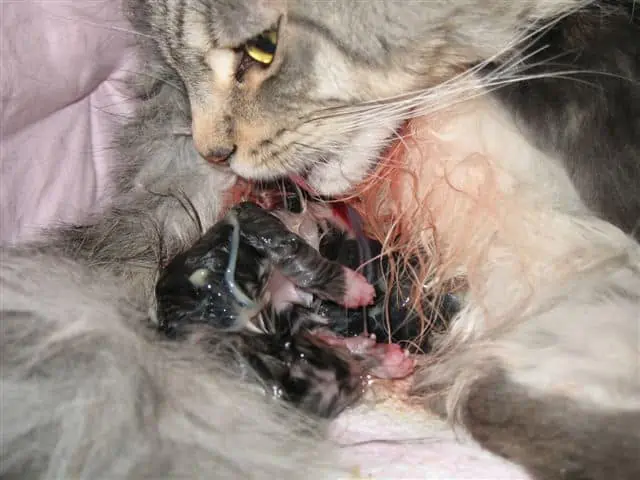
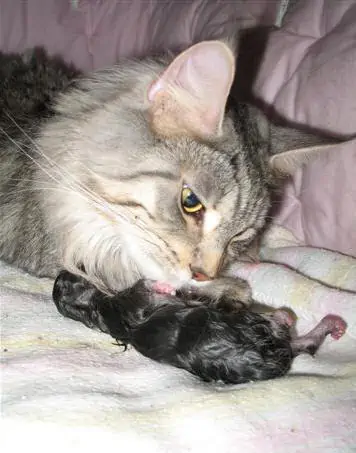
Depending on how well your cat is bonded with you she may allow you to remove the kittens into a warm box always leaving her with one kitten as the next arrives. Her moving around can possibly harm the newborns if she treads on them but too much intervention from a human can spoil the bonding process.
Helping with the Birth
If you are going to help with the birth you need a small birthing kit…minimal requirements are:
Watch or clock – to time intervals of birth of each kitten
Clean cloth or towelling face-washers that are sterile – to help dry a kitten or remove
fluid from the muzzle etc.
Small box – to hold kittens during the birth.
Polar fleece, baby blanket etc. and hot water bottle – to help warm dry new babies
Gloves – you may also need gloves so minimal human odour is transferred to kittens
Fresh bedding – to change soiled bedding and settle although this can be often best left until the next day.
Scissors – these are only required if you feel you cannot tear the umbilical cord but cutting can promote bleeding which will then need to be tied off.
Interventions
If the kitten is hanging by the undelivered placenta and the queen is moving around there is a risk of a hernia forming on the kitten so it can be advisable to separate the kitten from the placenta by clamping the cord firmly with fingers of one hand whilst breaking or tearing it on the side AWAY from the kittens body with the other. It is preferable not to cut cords as this can promote bleeding. Leave at least an inch/2.5 centimetres of cord or a little longer. DO NOT PULL ON THE PLACENTA as this can damage the uterus.
The first kitten can be lost with an inexperienced queen due to a protracted time in the birth canal and as she may delay removing the membrane. Take care that it is breathing on it’s own and if you think it is still born because of extended length of time in the birth canal rub gently to stimulate breathing.
If a kitten is making choking gurgling sounds there may be fluid in the airways and it is possible to help Taking the kitten in both hands with your fingers supporting the head and neck gently swing the kitten forward and downward and this may help remove the fluid from the airways..
If you are going to remove kittens and place them in a warm box – you can gently dry them with a warmed dry face washer. Always leave one kitten with the mother usually the last born and if she settles return them to her. Do not place a kitten on a hot water bottle directly although a warm bottle to one side of the box under the bedding will help them to dry and revive after the rigours of birth.
What can go wrong?
Generally cats give birth with minimal problems and do not require assistance. There are some things to be aware of however which are life threatening to the queen and her kittens which is why a cat needs to be observed
The birth canal can be too narrow
The uterus can be unprepared and unable to expel kittens
Kittens can be overly large or badly positioned or have died in-utero
Labour does not progress
Exhaustion can make the contractions weak
When to call the Vet?
These are Veterinary Emergencies and need immediate attention:
Prolonged contractions that are close together and go well past 1 hour
The queen has gone past her due date and has a foul smelling or greenish discharge
The litter has been delivered but the queen is sitting in the lion pose looking uncomfortable and not settled with her kittens – likely to be more kittens or an undelivered placenta.
After the birth what should I do?
 When you are sure that all kittens have been delivered and the queen is settling with her babies you can offer her some food and a drink – some queens like kitten milk – non lactose with an egg yolk and their raw wet food. Her food and drink should be left close by as should a litter tray and many a queen has to be offered breakfast in bed to encourage them to eat.
A quick check should reveal all kittens tucked in and some suckling already. If she is relatively dry and warm and you have not handled her kittens at all just leave her until the next day before changing bedding.
If you have been keeping her kittens in a dry box you may find you can change the bedding quickly and settle her in with them….then leave her to bond.
She will probably want or in the case of a new first time , need to be given peace and quiet for the next few days. Restrict disturbing her but check on her at least twice in a day as there are rare complications that can occur post birth.
Contact your vet if she shows poor muscle co-ordination, trembling, exceptional restlessness or has dark hot lumps on her mammary glands or dark discharges from the vagina.
How do I care for the newborn kittens?
Check that each kitten is suckling and in the case of long haired cats make sure that the nipple is not obstructed with hair that means the kitten is empty suckling.
Cleft palate can prevent useful suckling and sometimes affected kittens may need to be euthanized as repair is impossible.
In the early days the mother cares for the kittens almost totally. It can be useful to quickly weigh each kitten at the same time each day to be sure they are gaining weight and if they are not gaining supplementary feeding may be required – a good brand supplement is called Biolac.
Cats will move their kittens if they feel threatened and sometimes not to an appropriate new nest – this can happen any time but is often around 2 to 3 weeks of age.
Points to note
 Weaning can start any time from around 4 weeks up to 6 weeks of age
Female cats can come into heat again while nursing kittens often when the kittens are just a few weeks old
Kittens should be wormed around 6 to 8 weeks and kept flea free.
Kittens should not go to new homes under the age of 8 weeks while 10 to 12 weeks is preferred as kittens learn their social behaviour during this time both from their mother and also from siblings.
More Information: How to Care for Kittens which covers everything you need to know about raising and caring for kittens. Included: de-worming, feeding, sleeping, litter box training, health issues, fleas, hairballs and much more.