|
|
 |
What is Catnip? How does Catnip affect my cat?
|
If you’ve ever watched as a cat
"flipped" over fresh catnip perhaps you’ve been struck with
the question; "what causes Catnip to affect cats that way?"
Catnip is indeed an unusual phenomenon among cats, it has the
ability to alter your cat’s behavior like nothing else can. So
what exactly is the reason for what scientists have coined as
"the Catnip effect"?
Unfortunately for such inquisitive minds the exact reason of
why Catnip affects cats in such a manner remains mostly a
mystery. There is however much that we do know about Catnip
and cats even if we don’t have the ultimate answer of exactly
"why?" yet answered.
The Science Stuff
Catnip
is scientifically classified as Nepeta cataria and is a
perennial herb from the mint family and is in fact also
referred to as "Catmint". It is a plant indigenous to Europe
but has been exported and is now found all over including the
United States and Canada.
The active ingredient in Catnip is an oil; Nepetalactone,
which is found in the leaves of the plant. This is the reason
you are able to find Catnip in a bottle or spray form in some
pet stores.
Other Uses For Catnip
Catnip is not only good to stimulate activity in cats, it can
also be used by humans as an herb for a medicinal tea which
may soothe toothaches, help against coughs, and may also
perform as a sleep aid. Furthermore, Catnip can be used as an
herb on salads or other foods as has been the case for
centuries in France. Lately Catnip has also been garnering
favor as a natural insect repellent rivalling the effectiveness
of many store bought varieties of repellent.
Catnip and Kitty
Catnip affects approximately half of all cats. What determines
whether or not a cat will react to Catnip is a genome that is
inherited (or not inherited as the case may be) at birth.
Kittens, regardless of whether or not they carry this genome,
do not react to Catnip until reaching about 3 or 4 months of
age and becoming sexually mature. Older cats are also more
likely to have a diminished or non-existing reaction to
Catnip, which leads scientists to believe that the Catnip
effect is based at least partially on sexuality and that the
reaction may be something like an aphrodisiac. Further adding
to this belief is the similarity of a sexual pheromone found
in the urine of the male cat to nepetalactone (the active
product in Catnip).
Cats that can be traced to regions where Catnip is not
indigenous appear to be unaffected by Catnip. The domesticated
housecat is not the only cat that may be affected by Catnip.
Larger cats can also be affected by the Catnip effect, felines
such as the bobcat, lynx, tiger and even lion are known to
react much the same way the common housecat would. It is
interesting to note that while Catnip can act as a stimulant
when a cat sniffs it, it can conversely act as a relaxant if
ingested. Therefore, you may see a different, nearly opposite
result depending on whether your cat chooses to eat the Catnip
you provide for him/her or merely sniffs it (the latter being
the more typical behavior).
How to Use Catnip With Your Cat
Catnip can prove to be a very useful tool for a few common
problems with your cat. If you are lucky enough to have a cat
that does react favorably to Catnip then here are a couple of
ideas for you and your furry little friend.
Catnip and Lazy Cats:
Catnip can be used to get a lazy cat off his or her butt. Some
cats are notoriously lazy, choosing to sleep much of their day
away in a nice golden patch of sunlight on the living room
carpet, only waking up to eat and gather some necessary
attention from their indulgent owners. If this sounds like
your cat, you may soon see (if you haven’t already) that your
cat is becoming more and more round. This is generally not a
good thing. Catnip may be able to help. Presenting catnip to
your cat encourages activity (of course provided the cat
sniffs rather than eats the herb).
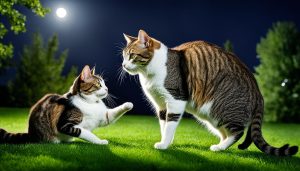
Many adult cats will respond to Catnip in a manner that
resembles their childlike kitten hyperactivity, jumping,
playing and running around as if it was given an injection of
kitty adrenaline, which in essence, is the case. The effect of
Catnip on a cat can last somewhere between two and fifteen
minutes. If the latter is the case, then this is a decent
amount of exercise and will help keep your cat a little more
svelte than without a Catnip treatment. Furthermore, if you
leave the Catnip out for a few hours then your cat may return
to the herb later (an hour or two after the effect has worn
off) and again react in an energetic fashion. So in this sense
you may consider Catnip sort of like a kitty energy drink.
Catnip and Cats That Scratch
Furniture:
If you have a cat that seems bent on the destruction of your
furniture then Catnip may again be able to come to the rescue.
Cats can be frustratingly picky about just about anything
under the sun including where they want to sharpen their
furniture destroying claws. It is not uncommon for a cat to
damage or destroy a piece of furniture just because the owners
finally gave up on trying to redirect their cat to the unused
cat scratching post that set them back anywhere up to a
hundred dollars and more. A good way to attempt to change this
frustrating and expensive behavior is to rub some Catnip or
Catnip oil on a scratching post that you are attempting to get
the cat to use. Introduce your cat to the newly "Catnipped"
scratching post and see how he/she reacts. If all goes well,
your cat will sniff and inspect the post and then begin
clawing at it. After a few times (you may have to re-Catnip
the post) hopefully kitty will be trained to use the post
rather than the sofa.
Using Catnip with Multiple Cats
If you’ve never used Catnip before and you have more than one
cat it is advisable to try it out individually on each cat
before introducing it to all of your cats at the same time.
The reason is because Catnip affects some cats in a negative
manner causing the cat in question to become aggressive rather
than merely playful. Introducing it to your cats individually
enables you to control the situation and keep a cat that may
react aggressively isolated from your other cats. This of
course means avoiding a possible catfight that could result in
broken furniture, hurt kitties (possibly requiring a vet
visit), annoyed neighbors (and probably owners), or a
combination of all of the above.
Growing Catnip
Growing your own Catnip plant can be rewarding as it can save you
money, give you the satisfaction of doing something yourself
and ensuring that you always get fresh, high-quality Catnip
for your cat. A word of caution however; the exact kitty
reaction you want to grow your own Catnip is something to be
wary of. If you plan on growing your Catnip plant out of doors and
other cats can access your Catnip garden then be prepared for
unwelcome feline visitors. This may not be a problem for you
personally, but cats are by nature territorial and if you have
a cat that lives alone without the company of other cats this
could prove to be an area of stress for your cat. Even if you
keep your cat inside at all times, your cat may get agitated
if he/she looks out the window to see another cat frolicking
in territory your cat considers his or her own. If you choose
to grow your Catnip indoors, be careful to keep it out of
reach of kitty. Otherwise you’ll likely have Fluffy jumping up
on furniture even to the most out of the way place to get
access to the tempting herb. Cats are great jumpers and not
really known for respecting precious household knick-knacks.
So if you do decide to grow catnip indoors for a cat that reacts
to Catnip, be careful to grow it in a place that your cat
won’t be able to access it. A room that you always keep closed
to the cat is probably the best solution for indoor grown
Catnip.
If you do find that your cat reacts positively to Catnip you
should be sure to use it sparingly so as not to dull the
effect which can be the result of overexposure. A good rule of
thumb is to not treat your kitty more than once a week on
average to Catnip.
Given all the positive effects that Catnip may have on your
cat you owe it to yourself (and naturally your fluffy little
ball of affection) to see how he/she reacts to this strange
and well known herb. It will provide enjoyment and exercise
for your cat and most likely an entertaining show for yourself
as well. It’s a win win situation.
Andy Markison is an illustrator, graphic designer, animal
lover and pet owner living in Germany. His website,
ZapGraphix.com, sells fun and humorous pet related
merchandise.
Article Source:
http://EzineArticles.com/?expert=Andrew_Markison
|