
What Are The Different Types Of Fleas?
Flea is the everyday name and an umbrella term for the Siphonaptera order that covers over 2.500 species (including cat fleas, dog fleas, rat fleas, human fleas, etc.).
All flea species are small and wingless insects. They live as external parasites on warm-blooded animals and are sanguivorous (feed on blood). In addition to being a hard-to-eliminate nuisance, fleas pose several health hazards to the host.
What Are Cat Fleas?
The cat flea (Ctenocephalides felis) is the most common flea species and a true cosmopolitan – it can be found almost everywhere in the world.
Also, do not get confused by the name – the cat flea attacks other hosts. In fact, the cat flea is the most common type of flea infesting dogs and humans.
Cat Fleas: Size
Cat fleas are reddish-brown to black tiny insects – an adult flea is less than ⅛ inch (4 millimeters) long, meaning they are smaller than a grain of rice. Female fleas are slightly larger than males.
Cat Fleas: Anatomy
The cat flea has an elongated and laterally compressed body with a sloping forehead. On the posterior end of the body, fleas have a sensory organ called pygidium, which detects air currents and vibrations. On the anterior end, they have mouthparts.
The mouth of adult fleas is adapted for piercing the host’s skin and sucking blood (larvae have chewing mouthparts and feed on the feces of adult fleas). Adult fleas can change hosts and bite repeatedly.
Fleas are wingless and cannot fly. However, they have three pairs of powerful legs and make excellent jumpers. Interestingly, despite their miniature size, fleas can jump up to 33 centimeters.
Cat Fleas: Reproductive (Life) Cycle
Cat fleas classify as a holometabolous species, which means they undergo full metamorphosis (which lasts between 30-75 days). They have four life stages, including:
- Eggs: Laid on the host after the adult female has had its first blood meal. The white, translucent, non-sticky, and oval eggs fall from the host into the environment, where they continue developing.
- Larvae: Feature translucent exoskeletons and visible dark guts. They are sensitive to temperature, humidity, and light (prefer dark) and feed on flea dirt (feces).
- Pupa: Develop when the larvae spin adhesive (sticky) silk cocoons. Pupae sense air currents, vibrations, and carbon dioxide fluctuations and use them to determine the right time to emerge.
- Adult (Imago): After emerging, adult fleas are ready to jump on a host and start feeding/reproducing. During its lifetime, a female flea can lay between 2000 and 8000 eggs (however, most fleas lay only 100 eggs before being ingested by the host during grooming).
Only adult fleas interact with the host – the other stages live and develop in the environment. Also, adults represent the smallest fraction of the flea population – only 5%. Eggs account for 50% of the population, larvae for 35%, and pupae for 10%.
Cat Fleas: Behavior
Unlike most parasites, fleas are not very social. Simply put, they do not spend much time on their host – in general, fleas live in the host’s sleeping area (bed, blanket, carpet) and jump onto the host only when it is mealtime.
Cat Fleas: Lifespan
If the conditions (temperature and humidity) are favorable and there is a constant food source, fleas can live up to two or three years. Without a host, the lifespan is much shorter – less than two weeks.
Why Are Cat Fleas Dangerous?
Cat fleas are a health hazard on several levels. Some flea-related risks are easy to manage. However, others can be life-threatening, especially if left untreated. Let’s take a close look at why fleas are dangerous to cats and kittens.
Skin Irritation
First of all, fleas cause irritation. The irritation makes cats itch, scratch, and bite themselves, which has two complications.
First, self-inflicted scratches and bites can get infected (secondary bacterial infections). Second, the irritation results in anxiety, thus harming the cat’s emotional well-being.
Flea Allergy Dermatitis (FAD)
Flea allergy dermatitis, or shortly FAD, is a specific skin infection caused by an allergic reaction to flea saliva. Namely, during mealtime, fleas inject saliva into their hosts.
Some cats are sensitive to the proteins found in the saliva and develop an allergic reaction. Interestingly, in a sensitive cat, even one flea bite can trigger a FAD episode.
Cat Scratch Disease (CSD)
Fleas can carry the bacteria Bartonella henselae. They pick up B. henselae when feeding on infected cats and then transmit the bacteria to healthy ones. In cats, the bacteria causes occasional fever and abortion (in pregnant queens).
Despite the name, cat scratch disease refers to a human issue. Namely, it may develop when a cat infected with B. henselae bites or scratches a person. While easily treatable, CSD in humans can result in severe complications if left unmanaged.
Tapeworms
The cat flea is an intermedium host for the most common tapeworm among pets (cats and dogs) – Dipylidium caninum. Because of its close relation with fleas, the tapeworm is popularly known as the “flea tapeworm.”
Tapeworm infestations in cats cause diarrhea, appetite changes, and poor coat quality. In kittens, they can result in poor growth and development.
Anemia
Lastly, fleas can cause anemia. This is especially true for heavy infestations in young kittens. In fact, in young kittens, such infestations, followed by anemia, can be fatal. Cats and kittens with anemia have pale gums, difficulty breathing, and are lethargic.
Note: These flea dangers apply to cats. However, as explained, cat fleas infest other pets and humans too, and pose a danger to them as well. For example, in humans, fleas are responsible for transmitting severe diseases such as plaque and typhus.
Fact: According to a 2018 study, “as high as 80% of fleas collected from cats contain at least one organism that could induce illness in cats or people”.
How Do I Know My Cat Has Fleas?
Intense, or even fanatic itching, is the most striking sign a cat has fleas. However, it is not specific – cats can scratch a lot due to a variety of reasons. Also, itching is not the only sign a cat has fleas. Here are some red flags:
Itching & Biting
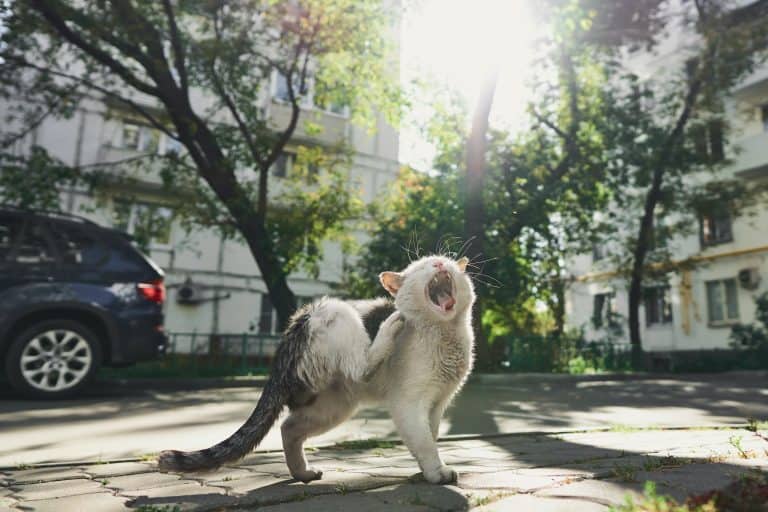
The first sign of a flea infestation is itching. The presence of fleas makes the skin irritated. As a response, cats itch, scratch, or even bite themselves. Depending on the severity of the itchiness, the self-injuries can be extensive and sometimes become infected.
Flea Dirt On Coat
The presence of pepper-like specks on the cat’s coat is another telltale sign. The dark brown or black specks are, in fact, flea feces and are commonly known as flea dirt. Flea dirt can be found anywhere on the cat, but it is most dense in the neck and rump.
Tip: To check whether the pepper-like specks on your cat’s fur are flea dirt, you can make a simple experiment: comb your cat over a white paper towel and then mist the fallen granules with water. If they turn red, the experiment is positive, and your cat has fleas. The reason the dirt turn red is it contains blood.
Grooming (More Than Usual)
Cats are notorious for their dedication to regular grooming. However, grooming more than usual can be a sign of fleas. During grooming, cats accidentally ingest fleas, which may result in illnesses if the fleas are infected.
Skin Irritation & Scabs/Bumps
The skin irritation exacerbates over time. Cats with fleas often have red skin, and in some cases, there can be additional skin lesions. Scabs and small red bumps are the two most common lesions associated with flea infestations.
Hair Loss
The constant itching, skin irritation, and excessive grooming may result in hair loss. The bald patches are usually distributed on the neck, hind legs, and base of the tail.
Rice Grains (Bed & Around The Anus)
Another sign of a flea infestation is the presence of rice grains around the cat’s anus or on its bedding. The rice grains are, in fact, tapeworm eggs. Tapeworms have a complex life cycle, which in one stage requires an intermediary host (a flea). Cats become infected when they accidentally ingest infected fleas during grooming sessions.
Note: Cats can also get tapeworms from eating worm-infected prey. Therefore, finding tapeworm eggs does not always indicate a flea infestation. However, in indoor cats that do not hunt, fleas are the most likely culprit.
Restlessness & Irritability
The itchiness can literally make cats act like crazy. Due to the constant irritation, cats can be restless – pace around, be unable to find a comfortable position, and simply act out of the ordinary. Some cats can even be aggressive and prone to snapping.
What Should I Do If My Cat Has Fleas?
Getting rid of a flea infestation can be a challenge. A successful strategy is based on a multimodal approach that includes:
- Treating The Infested Cat: The first and most important step is getting rid of the fleas on the cat. Luckily, the modern market offers many anti-flea products – from spot-on liquids that kill fleas to special shampoos that soothe the skin and help with the symptoms. The vet will recommend the best treatment strategy.
- Treating Other Pets In The Household: In multi-pet households, it is vital to treat all pets. If one pet has fleas, chances are the others have them too. Therefore, even if you treat the cat, it will eventually get re-infested.
- Treating The Environment: Finally, you need to treat the environment. As previously said, adult (visible) fleas represent the smallest fraction of the flea population. For every adult flea on the cat, there are many more eggs, larvae, and pupae around the house (which, at some point, will reach the adult stage and re-infest the cat). Consult with the vet about which products are safe to use around cats. In severe cases, you may need to ask for help and hire a professional exterminator.